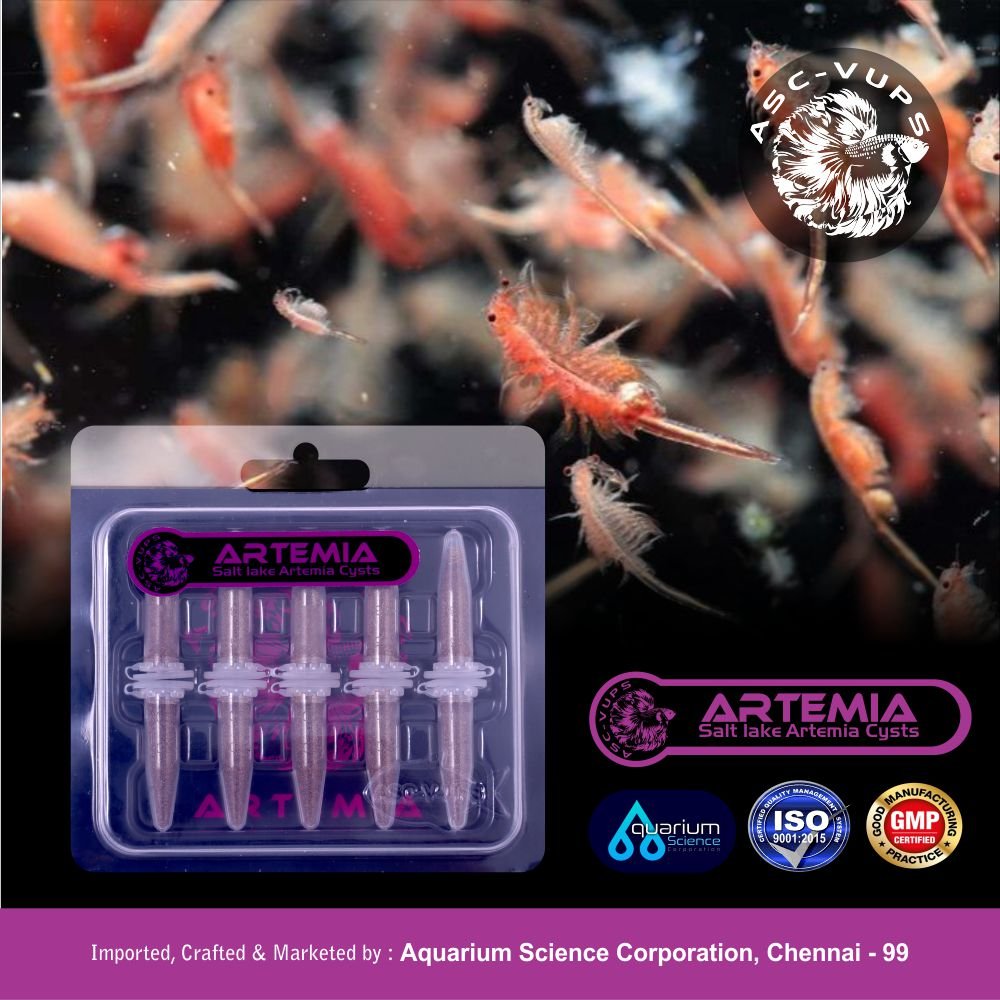
If there’s one live food that virtually every aquarist has used at some point, it’s Artemia—better known as brine shrimp. For decades, these tiny crustaceans have been the backbone of fish breeding programs, fry-rearing operations, and feeding regimens for picky eaters. Ask any experienced breeder what single live food they couldn’t do without, and most will answer: baby brine shrimp (BBS). There’s a reason they’re considered the gold standard. **What Makes Artemia Special?** Artemia salina and related species are small crustaceans that live in hypersaline water bodies worldwide. What makes them incredible for aquarists is their eggs—cysts that can remain viable for years in storage, then hatch within 24 hours when placed in salt water. This means you can maintain a shelf-stable \”live food\” source that requires no feeding, no ongoing maintenance, just hatching on demand. **Why Fish Need Live Foods** **Movement triggers feeding response:** Many fish, especially fry, won’t recognize static food. Moving prey triggers hunting instincts. **Complete nutrition:** Live brine shrimp contain proteins, fats, vitamins, and minerals in bioavailable forms that processed foods can’t perfectly replicate. **Behavioral enrichment:** Hunting and capturing prey provides mental stimulation that enhances fish health and reduces stress-related behaviors. **Breeding conditioning:** Fish fed rich live foods come into breeding condition faster and produce higher quality offspring. **Who Needs Artemia?** **Fish breeders** consider BBS essential. Most egg-laying species’ fry can eat newly hatched BBS, making it the perfect first or second food after fry become free-swimming. **Picky eater recovery:** Fish refusing other foods often can’t resist live brine shrimp. It’s the gateway food that reestablishes appetite. **Show fish preparation:** The superior nutrition from live foods enhances coloration and conditioning for competitive showing. **Saltwater aquarists** use adult brine shrimp or BBS as regular supplemental feeding for many marine species. **Treating constipation:** Live BBS acts as mild laxative due to chitin content and hydration, helping fish with digestive blockages. **Setting Up a Basic Hatchery** You don’t need expensive equipment. A simple setup works: **Container:** 2-liter soda bottle with bottom cut off, inverted, works perfectly. Or use dedicated brine shrimp hatchery. **Salt water:** Mix marine salt or kosher salt at 1-2 tablespoons per liter. pH 8-9 is ideal. **Aeration:** Vigorous air stone keeps eggs suspended and provides oxygen. **Light:** Bright light near hatchery improves hatch rates and makes harvesting easier (nauplii swim toward light). **Temperature:** 78-82°F is optimal. Warmer = faster hatching (18 hours), cooler = slower (30+ hours). **The Hatching Process** 1. Fill hatchery with salt water at proper temperature 2. Add brine shrimp eggs (1-2 teaspoons per liter) 3. Provide strong aeration 4. Wait 18-36 hours depending on temperature 5. Turn off aeration, let settle 5-10 minutes 6. Shine flashlight at bottom—nauplii swim toward light 7. Siphon concentrated nauplii from bottom 8. Strain through fine mesh, rinse with fresh water 9. Feed immediately to fish **Separating Shells from Nauplii** Unhatched eggs and empty shells float or sink, while live nauplii swim mid-water. After turning off aeration: – Shells float to surface – Unhatched eggs sink to bottom – Live nauplii concentrate in middle Siphon from middle zone into fine mesh strainer for cleanest harvest. **Feeding Quantities** **For fry:** Feed small amounts 3-4 times daily. You should see visibly orange bellies after feeding (nauplii are orange). **For adults:** Feed 2-3 times weekly as supplemental food. Amount depends on tank size and fish number—start small and adjust. **Monitor water quality:** Live foods add bioload. Don’t overfeed or water quality will degrade. **Improving Hatch Rates** **Use quality eggs:** Hatch rate should be 80%+. Poor quality eggs waste salt, effort, and produce shells without nauplii. **Decapsulate eggs:** Removing the hard…