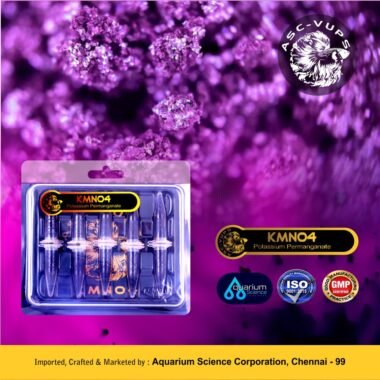
When most aquarium treatments fail, when parasites won’t die, when fungus keeps spreading, when your last resort is draining the tank and starting over—there’s one more option: potassium permanganate. Known by its chemical formula KMnO4, this powerful oxidizer has been used in aquaculture and fishkeeping for decades to tackle the most stubborn problems. It’s not your first choice for treatment, but when you need the big guns, nothing else compares. **What Is Potassium Permanganate?** KMnO4 is a strong oxidizing agent that appears as dark purple crystals. When dissolved in water, it creates a bright pink/purple solution that destroys organic compounds, kills parasites, eliminates bacteria and fungus, and oxidizes toxins. It’s used in water treatment, medical applications, and industrial processes. In aquariums, it’s a powerful but risky tool that requires respect, precision, and understanding. **The Power and the Risk** This is not like other aquarium medications. KMnO4 is dangerous if misused. It can burn fish skin, damage gills, and kill everything in your tank—fish, plants, bacteria—if overdosed. But when used correctly, at proper concentrations, it can save fish that nothing else can help. **When to Use KMnO4** **Severe external parasite infestations** resistant to gentler treatments. When ich or velvet won’t respond to standard medications, a KMnO4 dip can eliminate them. **Stubborn fungal infections** that spread despite antifungal treatments benefit from KMnO4’s powerful oxidizing action. **Bacterial infections** on skin or fins, especially secondary infections after injuries, respond to short KMnO4 baths. **Anchor worms and fish lice**, large visible parasites, can be killed with KMnO4 dips before manual removal. **Pond fish entering quarantine** from outdoor environments often get prophylactic KMnO4 baths to eliminate hitchhikers. **Egg disinfection** for breeders: gentle KMnO4 solutions can disinfect fertilized eggs, preventing fungus. **When NOT to Use It** Don’t use KMnO4 as your first treatment option. Try safer medications first. Don’t use it in tanks with plants you want to keep—it will damage or kill them. Don’t use it in tanks with sensitive species unless you’re treating in a separate container as a short dip. Don’t use it if you’re not confident measuring precisely—guessing doses can kill fish. **Types of Treatment** **Short dips (30 seconds to 2 minutes):** Used for severe external parasites. Fish are dipped in concentrated solution briefly, then returned to clean water. Concentration: 10 ppm (mg/L). **Extended baths (10-30 minutes):** For moderate infections. Fish spend longer in lower concentration solution. Concentration: 2-4 ppm. **Tank treatment (not recommended for beginners):** Adding KMnO4 directly to tanks for 24 hours. Extremely risky with plants and beneficial bacteria. Concentration: 2 ppm. **How to Safely Perform a KMnO4 Dip** This is critical—follow exactly: 1. Prepare a dip container with clean, dechlorinated water matching your tank temperature and pH 2. Calculate precise dose: For 10 ppm in one gallon, use 10 mg of KMnO4 powder. Use a scale that measures milligrams accurately. 3. Dissolve crystals completely before adding fish. The solution should be bright pink/purple. 4. Net fish from main tank and place in dip. Keep net handy. 5. Watch the fish constantly. Look for distress signs: rapid breathing, violent darting, loss of equilibrium. 6. If fish shows severe distress, immediately remove it back to the main tank. 7. If fish tolerates it, leave for 30-60 seconds (for 10 ppm) or longer for lower concentrations. 8. After treatment, return fish to main tank or clean water—never reuse dip solution. **Understanding the Color Change** As KMnO4 oxidizes organic matter, it changes from purple/pink to brown. If your dip turns brown quickly, it means there was a lot of organic matter present (parasites dying, slime coat material, etc.). If the solution stays vibrant pink…