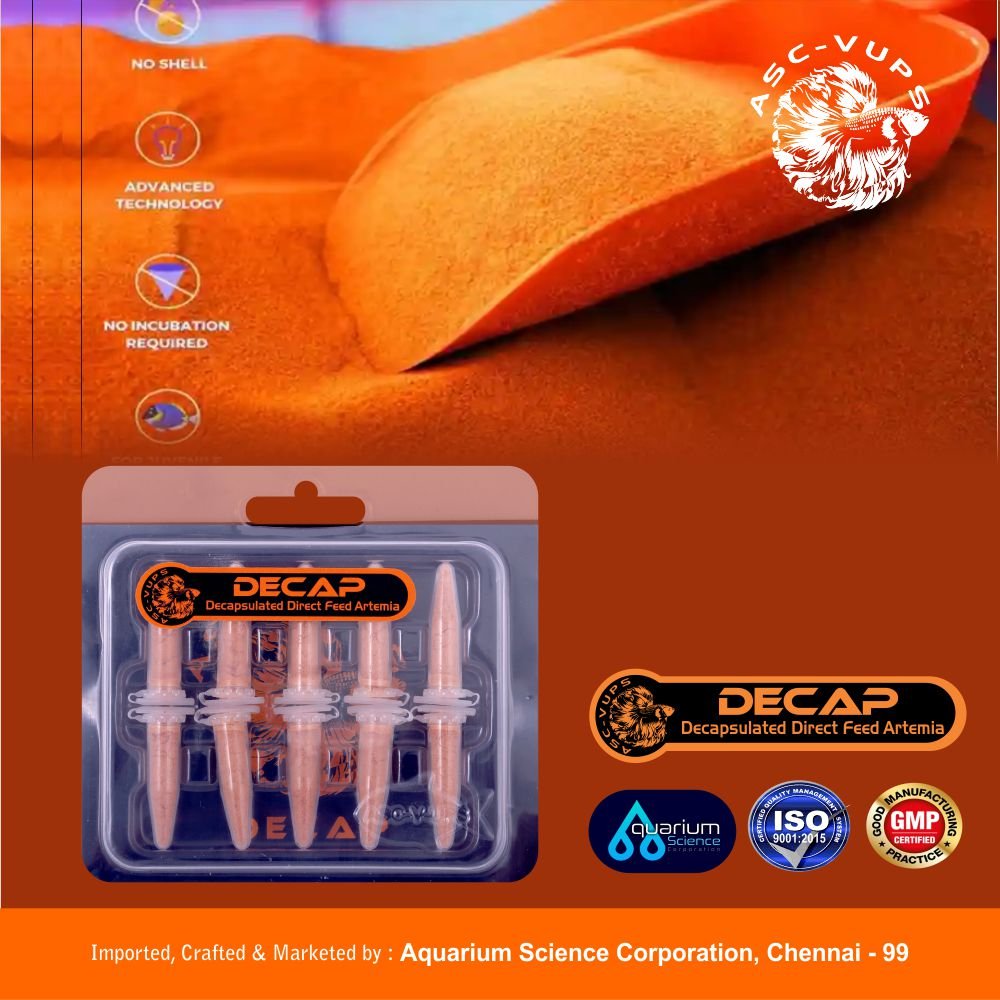
Anyone who has hatched baby brine shrimp (BBS) knows the routine: set up the hatchery, add eggs, wait 18-24 hours, harvest the nauplii, separate the shells, clean the hatchery. It works, but it’s time-consuming and messy. And those shells? They’re indigestible and can cause digestive issues if fish consume too many. You spend time carefully separating them from the hatched nauplii to avoid problems. What if you could feed brine shrimp eggs directly to your fish without hatching them first? That’s exactly what decapsulated brine shrimp eggs (decap) allow you to do. **What Are Decapsulated Brine Shrimp Eggs?** Decapsulated eggs are brine shrimp eggs that have had their hard outer shell chemically removed through a bleaching process. What remains is the nutritious embryo, fully digestible and safe for fish to consume. They look like small orange spheres, similar to fish eggs, and can be fed directly to fish of appropriate size or used to improve brine shrimp hatching efficiency. **Why Decapsulate?** The hard chorion (outer shell) of brine shrimp eggs serves no nutritional purpose. It protects the embryo in harsh environments but becomes waste once the embryo hatches—or a digestive hazard if consumed by fish. Removing the shell provides: – Direct feeding without hatching required – Improved digestibility and nutrition – No shell separation hassles – Higher energy content per unit (no wasted shell weight) – Better hatching rates if you do choose to hatch them **Two Primary Uses** **Direct feeding:** Decap can be rehydrated and fed directly to fish as a highly nutritious food source. The eggs are small (200-300 microns) and appropriate for fry and small fish. **Improved hatching:** If you prefer to hatch your own BBS, using decapsulated eggs improves hatching rates and eliminates shell contamination in your harvest. **Who Benefits from Decap?** **Fry breeders** raising fish too small for newly hatched BBS can feed rehydrated decap. It’s larger than rotifers but smaller than hatched nauplii—filling a size gap. **Small fish keepers** with species like killifish, small tetras, or dwarf shrimp can feed decap as part of regular diet. **Brine shrimp hatchery operators** get better hatching efficiency and cleaner harvests using decap instead of regular eggs. **Hobbyists who want convenience** can feed decap without maintaining hatcheries or timing feedings around hatching schedules. **Nutritional Profile** Decapsulated eggs provide: – High protein (50-60%) – Essential fatty acids – Vitamins and carotenoids – Highly digestible format – Complete embryonic nutrition Because the embryo hasn’t developed into a nauplius yet, the eggs contain all the stored nutrition intended to fuel early development—making them more energy-dense than hatched BBS. **How to Feed Decapsulated Eggs Directly** **Rehydration method:** 1. Place desired amount of decap in cup with dechlorinated water 2. Let soak for 30-60 minutes (they’ll plump up) 3. Strain and rinse 4. Feed immediately to tank **How much to feed:** Start small. A quarter teaspoon of dry decap rehydrates to significant volume. Feed only what fish consume in a few minutes. **Feeding frequency:** 1-2 times daily for fry, 2-3 times weekly for adult small fish as supplemental food. **Target feeding:** Use turkey baster or pipette to deliver directly to fry or small fish that might not compete well for food. **Using Decap for Improved Hatching** If you prefer the nutrition of freshly hatched BBS but want better hatching results: Set up hatchery as normal but use decapsulated eggs. Without shells, hatching rates improve (often 90%+ vs. 70-80% with regular eggs). When harvesting, you won’t have shells to separate. The entire harvest is pure nauplii, saving significant time and effort. Decap eggs sink rather than float (no buoyant shell), so adjust your hatchery…