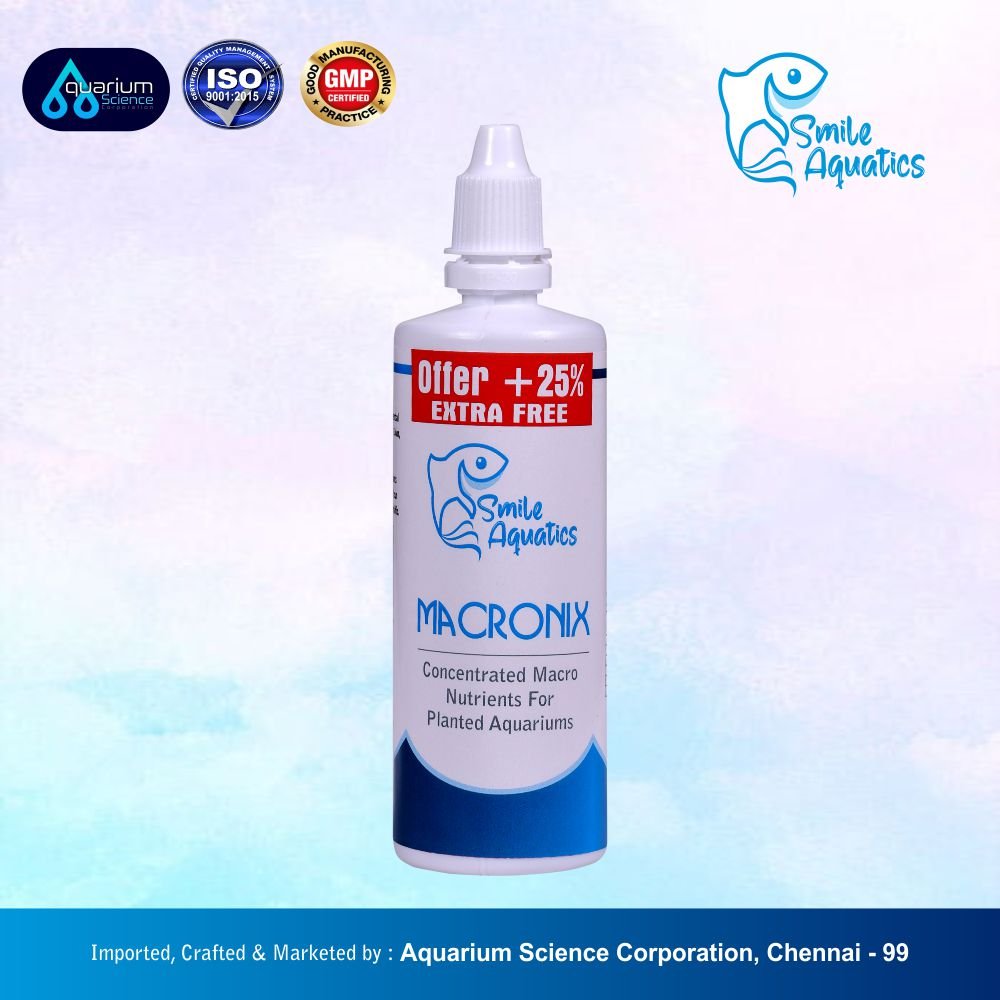
Macronutrient fertilization—nitrogen, phosphorus, potassium—is essential for plant growth. But in shrimp tanks, aggressive NPK dosing creates concerns about parameter swings, TDS buildup, and shrimp stress. MACRONIX Smile brings NPK supplementation to sensitive setups, formulated with shrimp welfare and small tank stability in mind. **The Shrimp Tank NPK Challenge** Shrimp tanks create unique fertilization dilemmas: **Plants need NPK** for growth **Shrimp produce some NPK** through waste (but usually not enough for robust plant growth) **High TDS stresses some shrimp** (Caridina especially) **Parameter swings stress all shrimp** **Small tank volumes** magnify every change MACRONIX Smile addresses these challenges with gentle, shrimp-considerate formulation. **What Makes Smile Different?** **Lower concentration:** Easier to dose precisely in nano volumes without overshooting **Minimal TDS impact:** Formulated to provide nutrients with minimal dissolved solids increase **Buffered chemistry:** Reduces pH swings from dosing **Shrimp-tested:** Designed considering invertebrate welfare **Precise nano dosing:** Easier measurement for 5-10 gallon tanks **Do Shrimp Tanks Need Macro Fertilization?** Depends on setup: **Lightly planted, heavily stocked:** Shrimp waste might provide adequate NPK. Supplementation optional. **Heavily planted, lightly stocked:** Plant demand exceeds waste production. Supplementation beneficial. **Using RO/DI water:** Pure water plus remineralization provides zero NPK. Supplementation necessary if plants present. **Growing demanding plants:** Stem plants especially need consistent NPK. Supplementation essential. Assess your specific balance between plant mass and shrimp population. **Dosing Strategy** **Start conservatively:** Begin at 50% recommended dose **Dose after water changes:** Replace what was removed **Frequency:** 1-2× weekly for most shrimp tanks (less than high-tech planted tanks) **Monitor TDS:** If TDS creeps too high, reduce dosing frequency or increase water change frequency **Watch shrimp:** Any stress signs mean reduce or eliminate dosing **TDS Management** Total Dissolved Solids (TDS) is critical in shrimp keeping: **Neocaridina (cherry shrimp):** Tolerate TDS 150-300 ppm relatively well **Caridina (crystal shrimp):** Prefer TDS 100-150 ppm; sensitive to increases **Each fertilizer dose** adds to TDS slightly **Water changes** reduce TDS back to remineralized water baseline Balance: Dose enough for plants, water change often enough to prevent TDS creep. **Nitrogen in Shrimp Tanks** Shrimp produce ammonia → bacteria convert to nitrite → bacteria convert to nitrate. **Result:** Shrimp tanks naturally produce some nitrogen (as nitrate) **Question:** If there’s natural nitrate production, why add more? **Answer:** In lightly stocked planted tanks, plant consumption exceeds shrimp production. Supplementation fills the gap. **MACRONIX Smile provides additional nitrate** when shrimp waste alone is insufficient. **Phosphate Considerations** Plants need phosphorus (as phosphate). Shrimp produce some through waste. **Adequate phosphate (5-10 ppm):** Supports plant health, doesn’t harm shrimp **Excessive phosphate (30+ ppm):** Can bind calcium, affecting shrimp molting MACRONIX Smile doses conservatively to support plants without excessive buildup. **Potassium and Shrimp** Potassium is generally safe for shrimp at plant-beneficial levels. It doesn’t bioaccumulate or cause direct toxicity issues. MACRONIX Smile provides adequate potassium for plant health without shrimp risk. **Plant Selection for Gentle Fertilization** Choose plants that thrive with modest NPK: **Easy stems:** Hygrophila, basic ludwigia, rotala rotundifolia **Mosses:** Java moss, Christmas moss **Rhizome plants:** Anubias, java fern, bucephalandra **Crypts:** Most cryptocoryne species **Floaters:** Frogbit, salvinia, dwarf water lettuce Avoid ultra-high-demand plants requiring aggressive fertilization. **Water Change Schedule** Shrimp tanks typically need frequent water changes: **25-30% weekly minimum** for water quality **After each change:** Dose MACRONIX Smile to replace removed nutrients **If TDS climbing:** Increase water change frequency rather than reducing fertilization (better for overall water quality) **Combining with Other Shrimp-Safe Products** Complete gentle nutrition: **MACRONIX Smile:** NPK foundation **MICRONIX Smile:** Trace elements **Iron FE Smile:** Additional iron if growing red plants **Shrimp-safe substrate:** Provides some baseline nutrition Layer products for complete yet gentle fertilization. **Breeding Tank Considerations** Serious breeders prioritize shrimp over plants: **Minimal fertilization:**…